
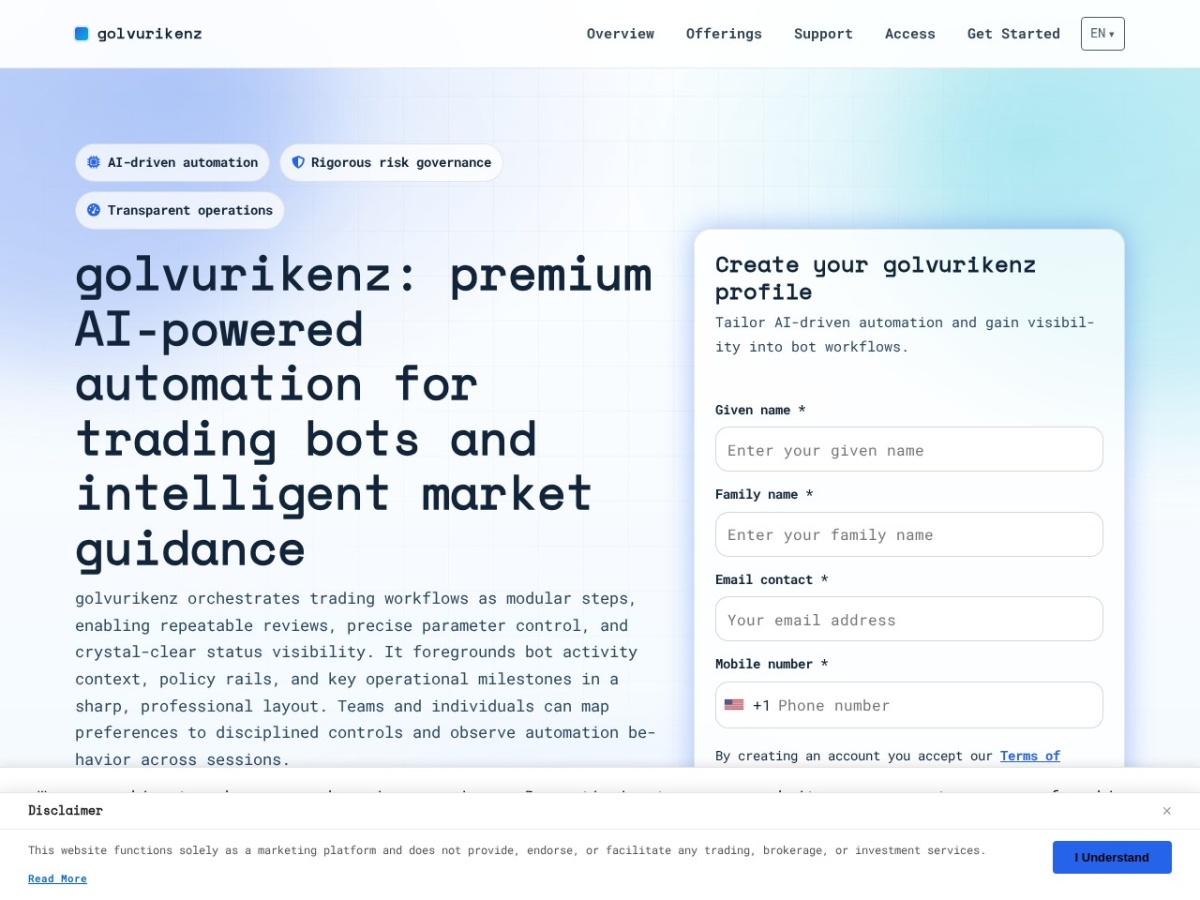
In the crowded landscape of AI-powered trading automation, a new name has emerged: Golvurikenz. Positioned as a premium solution for orchestrating trading bot workflows with clarity and control, the platform markets itself around structured configuration, risk governance, and transparent operations. But does it deliver on these promises, or is it simply another cleverly packaged marketing exercise designed to capture deposits from eager traders? After examining the available materials and architecture, the picture that emerges sits somewhere in the ambiguous middle ground that characterizes many modern fintech offerings.
The Core Promise: AI-Driven Automation with Human Oversight
Golvurikenz describes itself as an AI-powered framework for managing trading bots through modular, repeatable workflows. The emphasis throughout is on visibility and structure rather than guaranteed returns or flashy performance claims. The platform arranges automation into discrete stages: preparation, checks, execution handling, and review. Each phase is presented with readable status labels, organized parameter sets, and protective controls designed to keep bot behavior aligned with user-defined boundaries.
This approach differs from the typical trading automation pitch, which often leads with eye-catching profit percentages or promises of passive income. Instead, Golvurikenz foregrounds operational discipline. Users are expected to define how bots should operate by setting scaling inputs, safety thresholds, and session preferences within a cohesive interface. The system then applies AI-driven context across these parameters, offering stage-by-stage summaries and uniform terminology to support ongoing review.
The proposition is appealing on paper: bring structure to the chaotic world of automated trading, make bot behavior transparent, and provide the tools to tune risk exposure session by session. Whether the execution matches this vision is harder to verify without hands-on testing or independent user testimonials, neither of which are readily available in the public domain at this stage.
Workflow Architecture: Modular Steps and Readable Outputs
Golvurikenz presents its workflow as an eight-stage sequence, organized into structured steps that cover preparation, checks, execution handling, and review. The platform claims to offer twelve configuration groups for bot routines and AI-assisted adjustments, alongside ten protective settings framed as readable controls with expandable guidance tips.
This modular structure is designed to make automation repeatable and auditable. Rather than deploying a black-box algorithm that executes trades without explanation, Golvurikenz promises visibility into each decision point. Users can map their operating preferences to disciplined controls and observe how automation behaves across sessions. The interface is said to present concise status metrics in a layout optimized for rapid scanning on both desktop and mobile devices.
From a usability standpoint, this emphasis on clarity is noteworthy. Many automated trading platforms obscure their logic behind vague descriptions of proprietary algorithms or machine learning models. Golvurikenz, by contrast, claims to expose actionable context around automated actions, helping teams or individual traders assess how AI assistance applies across workflow steps. The challenge, of course, is whether these claims hold up under real-world use. The absence of third-party reviews or detailed case studies means prospective users must take these assertions largely on faith.
Risk Controls: A Structured Approach to Exposure Management
One of the more compelling aspects of the Golvurikenz offering is its presentation of risk controls. Rather than burying protective settings in advanced menus or leaving users to improvise their own safeguards, the platform organizes exposure limits, execution constraint templates, and operational checklists into a dedicated risk controls hub.
The system encourages users to define exposure boundaries that reflect their operating preferences and to keep them consistent across sessions for repeatable bot behavior. Sizing presets, session-level boundary reviews, and documented rule intent form the backbone of this approach. Order constraints are similarly structured, with templates that keep execution handling aligned with the workflow checks users review and maintain.
This methodical framing positions Golvurikenz as a tool for risk-aware traders rather than speculative gamblers. The platform acknowledges, implicitly, that automated trading carries inherent uncertainty and that success depends on disciplined configuration and ongoing review. The expandable guidance tips within the interface are designed to help users review key considerations at the right moment, aligning controls with AI-powered trading assistance in a structured, visible manner.
Still, risk controls are only as effective as the users who implement them. No amount of interface polish can compensate for poor judgment or unrealistic expectations. The platform's emphasis on user responsibility is a double-edged sword: it promotes accountability but also shifts the burden of success or failure squarely onto the shoulders of the individual trader.
The AI Assistance Layer: Context Without Hype
Golvurikenz refers to its AI capabilities as a context layer rather than a decision-making oracle. The system applies AI-driven trading assistance to support workflow context, structured checks, and readable status outputs. This framing is more restrained than many competitors, which often tout machine learning models trained on vast datasets as near-infallible market predictors.
Instead, the AI component here appears designed to augment human oversight rather than replace it. The platform exposes stage-by-stage summaries, parameter visibility, and uniform terminology to help users understand how automation is unfolding. This approach aligns with a growing recognition in the fintech sector that fully autonomous systems can produce catastrophic outcomes when market conditions shift unexpectedly or when edge cases arise that training data never anticipated.
By foregrounding bot activity context and policy rails, Golvurikenz positions itself as a co-pilot rather than an autopilot. Users retain control over configuration, review cadences, and the tuning of execution boundaries. The AI assists by organizing information, surfacing relevant checks, and maintaining consistency across sessions. Whether this division of labor proves effective in practice depends on the quality of the underlying models and the clarity of the interface, neither of which can be fully assessed without extended real-world testing.
The Onboarding Experience: Marketing or Gateway?
One of the most conspicuous elements of the Golvurikenz platform is its repeated insistence that the website serves as a marketing platform only. This disclaimer appears multiple times throughout the site and is reinforced in a modal pop-up that visitors must acknowledge. The implication is clear: the site itself does not provide, endorse, or facilitate any trading, brokerage, or investment services.
This positioning raises immediate questions. If Golvurikenz is purely a marketing vehicle, what exactly is being marketed? The registration form collects given name, family name, email contact, and mobile number, and users must accept terms of service, privacy policy, and cookie policy to proceed. The phrase "create your golvurikenz profile" suggests that some form of account or service exists beyond the marketing façade, but the exact nature of that service remains opaque.
This ambiguity is characteristic of many platforms operating in regulatory gray zones. By labeling the site as marketing-only, the operators may be attempting to sidestep obligations that apply to platforms offering actual trading or brokerage services. Whether this distinction holds up under scrutiny from financial regulators is an open question. For prospective users, the lack of transparency around what happens after registration is a significant red flag.
Security Readiness: Practical Checklist or Checkbox Exercise?
Golvurikenz presents a security readiness checklist covering access governance, configuration validation, status transparency, and session consistency. The guidance emphasizes consistent access patterns, regular review sessions, organized bot parameters, and verified safeguards before recurring workflows.
These recommendations are sensible and align with best practices for operational security in automated trading environments. Adopting consistent access patterns reduces the risk of unauthorized changes. Keeping bot parameters organized and verifying safeguards before each session helps catch configuration errors before they result in unintended trades. Relying on readable stage labels and summaries ensures that AI-assisted automation remains interpretable even as complexity scales.
However, a checklist is only as valuable as the enforcement mechanisms behind it. Does Golvurikenz provide tools to ensure users follow these practices, or is the checklist merely advisory? The materials do not specify whether the platform includes automated validation, audit logs, or alerts that flag deviations from established routines. Without such features, the security readiness checklist may function more as reassuring marketing copy than as a genuine operational safeguard.
The Timeline Roadmap: Four Stages of Workflow Maturity
Golvurikenz outlines a four-stage workflow roadmap designed to guide users from initial setup to ongoing refinement. The first stage involves establishing core rules by creating a foundational set of parameters reusable across sessions. The second stage adds AI guidance layers, applying AI-driven trading assistance to support workflow context, structured checks, and readable status outputs. The third stage focuses on standardizing risk controls, aligning protective boundaries with operating preferences using structured controls and expandable guidance tips. The fourth stage emphasizes ongoing review cadence, maintaining a repeatable rhythm for reviewing configurations, session outcomes, and workflow adjustments.
This progression reflects a maturity model common in enterprise software: establish baseline processes, layer on advanced capabilities, harden protective measures, and iterate continuously. The roadmap suggests that Golvurikenz is designed for users willing to invest time in configuration and refinement rather than those seeking instant, hands-off automation.
For serious traders accustomed to systematic approaches, this may be appealing. For casual users hoping to deploy a bot and let it run indefinitely without oversight, the roadmap signals that Golvurikenz is not the right fit. The platform demands engagement, review, and ongoing tuning. Whether users receive adequate support and documentation to navigate this roadmap is unclear from the available materials.
The FAQ: Clarity on Process, Silence on Performance
The frequently asked questions section provides brief, chat-style answers that clarify how automation is organized but avoid any discussion of performance, returns, or success rates. Users learn that Golvurikenz centers on AI-powered trading assistance and autonomous bots by arranging configurable workflows and visibility into status. Configurations stay readable through grouped parameters and labeled stages. Risk controls are presented as structured controls with expandable tips. The workflow accommodates different trading styles through configurable rule sets and session presets.
What the FAQ does not address is arguably more revealing. There are no questions about expected profitability, historical performance, drawdown management, or comparison with competing platforms. The omission of performance-related content may reflect regulatory caution or a recognition that such claims are impossible to substantiate in a general context. It may also indicate that Golvurikenz is primarily a workflow management tool rather than a trading strategy provider.
Prospective users should note this silence. A platform that emphasizes process over results may be positioning itself to avoid liability for trading losses, but it also suggests that success depends entirely on the quality of the strategies users bring to the table. Golvurikenz provides the scaffolding; users must supply the blueprint.
Red Flags and Regulatory Ambiguities
Several aspects of Golvurikenz warrant caution. The repeated insistence that the site is a marketing platform only, combined with a registration process that collects personal data and requires acceptance of terms, suggests an ambiguous relationship between marketing and service delivery. The lack of detail about what users gain access to after registration is troubling. Are they directed to a third-party broker? Do they receive access to proprietary software? Is the platform itself hosted elsewhere, with the marketing site serving merely as a lead generation funnel?
The absence of verifiable performance data, independent reviews, or testimonials is another concern. Established platforms in the automated trading space typically showcase backtested results, live trading statistics, or at least aggregated performance metrics. Golvurikenz offers none of these. The emphasis on workflow structure and risk controls, while commendable, cannot substitute for evidence that the platform actually supports profitable trading.
Regulatory compliance is also opaque. There is no mention of licensing, registration with financial authorities, or adherence to specific regulatory frameworks. The terms of service and privacy policy are referenced but not excerpted or summarized in a way that would allow prospective users to assess the platform's legal standing. In jurisdictions with stringent fintech regulations, this lack of transparency could be disqualifying.
The Verdict: Proceed with Eyes Open
So is Golvurikenz a scam or a legitimate tool? The honest answer is that the available evidence does not support a definitive conclusion in either direction. The platform presents a coherent, if somewhat opaque, value proposition centered on structured automation and risk-aware controls. The emphasis on user responsibility, transparency, and iterative refinement aligns with principles that serious traders would recognize as sound.
At the same time, the lack of verifiable performance data, the ambiguous regulatory posture, and the gap between marketing claims and operational detail raise legitimate concerns. The platform's insistence on framing itself as marketing-only while soliciting user registrations suggests an attempt to navigate regulatory boundaries in ways that may not withstand close scrutiny.
For investors considering Golvurikenz, the path forward demands diligence. Do not assume that the platform's professional presentation guarantees legitimacy. Seek out independent reviews, verify any claims through third-party sources, and approach with the understanding that you bear full responsibility for outcomes. The platform may well deliver on its promise of structured, transparent automation, but absent concrete evidence, that remains an assumption rather than a certainty.
Golvurikenz appears to occupy the uncertain middle ground between innovative fintech tool and cleverly packaged marketing exercise. It presents enough substance to avoid dismissal as an obvious scam, but not enough transparency to inspire full confidence. In such cases, the prudent course is cautious exploration with limited exposure, treating the platform as an experiment rather than a cornerstone of your trading strategy.
Ultimately, the burden rests with the individual investor to verify claims, understand risks, and make informed decisions. Golvurikenz may prove to be a valuable tool for disciplined traders seeking to bring structure to automated workflows, or it may turn out to be another in a long line of platforms that promise much and deliver little. Time, user feedback, and regulatory clarity will tell. Until then, proceed with eyes open and expectations tempered by realism.
---
The facts and data for this material were provided by the company Golvurikenz as reference material for this independent review.